
Publicly Owned Electricity
Executive summary
We must treat the electricity market as a public utility, not a source of profit.
Aotearoa needs an electricity system that produces affordable renewable energy to support a thriving economy and lower household living costs.
In addition, the electricity grid will need to expand. This will enable our transport and industrial sectors to transition away from fossil fuels and allow New Zealand society to manage the impacts of climate change.
DOWNLOAD THIS PAPER
The partial privatisation of our electricity system has prevented growth in our generation capacity. A state of manufactured scarcity has delivered rising energy bills for households and businesses and huge dividends to gentailer shareholders.
Treating the electricity market as a source of profit has led to us this point. Shareholders have been operating rationally, seeking to maximise their returns. The government is one of the chief beneficiaries of this dynamic as it holds a 51% stake in three of the big four gentailers.
Assuming that more market solutions will deliver better outcomes in New Zealand is to believe that these same actors will behave irrationally. The challenge is that electricity provision is a public utility, not a freely tradable good.
We need to fundamentally change our approach to delivering electricity. Electricity supply and demand should be managed as an economic development and industrial policy problem – not a revenue maximising concern for shareholders.
The NZCTU proposes that the Crown should use its dividends from its shareholdings in more active ways. First, the Crown should use some or all of its dividends to progressively bring the gentailer back into full public ownership. The larger dividends that are paid, the faster the gentailer will return to public ownership over time.
Second, the Crown should use its power as a major shareholder to direct the gentailers to support the development of the wider economy and the delivery of a more resilient electricity network. Bringing on new generation should be a priority, as should be the goal of delivering the green energy transition.
Electricity markets and the Government’s response to failings within them were chosen for further investigation by the NZCTU because they came up so often in discussions with workers. Families are finding it increasingly hard to pay the electricity bill, despite doing all they can to manage their use. Lower-income workers are having to make increasingly difficult decisions about what to sacrifice so that they can keep the heating on.
Working people are also concerned because they can see the impact rising energy bills are having on their workplaces. Across the country enterprises are closing, both in response to the mismanagement of the economy from this Government and rising cost of energy inputs. This is having devastating impacts on some communities, particularly in provincial New Zealand.
If we don’t tackle this problem decisively, New Zealand will continue to deindustrialise at pace, meaning the loss of good jobs, incomes, and security for many New Zealand workers. Poorer New Zealanders will also be confronted with rising electricity bills, deepening the cost-of-living crisis.
The choice now rests with political parties. They need to decide whether they will deliver the bold and necessary change to lift New Zealand’s economic performance and make energy more affordable, or do nothing and continue with a system that is driving deindustrialisation and energy poverty.
Sign the Open Letter Calling on the Public Ownership of Electricity
Introduction
Due to rising energy costs, the New Zealand economy is deindustrialising and thousands of New Zealanders are unable to heat their homes.
Over the past ten years, many things have changed in New Zealand. The government (twice). The country has weathered COVID and economic downturns. The population has grown by a little less than a million people.
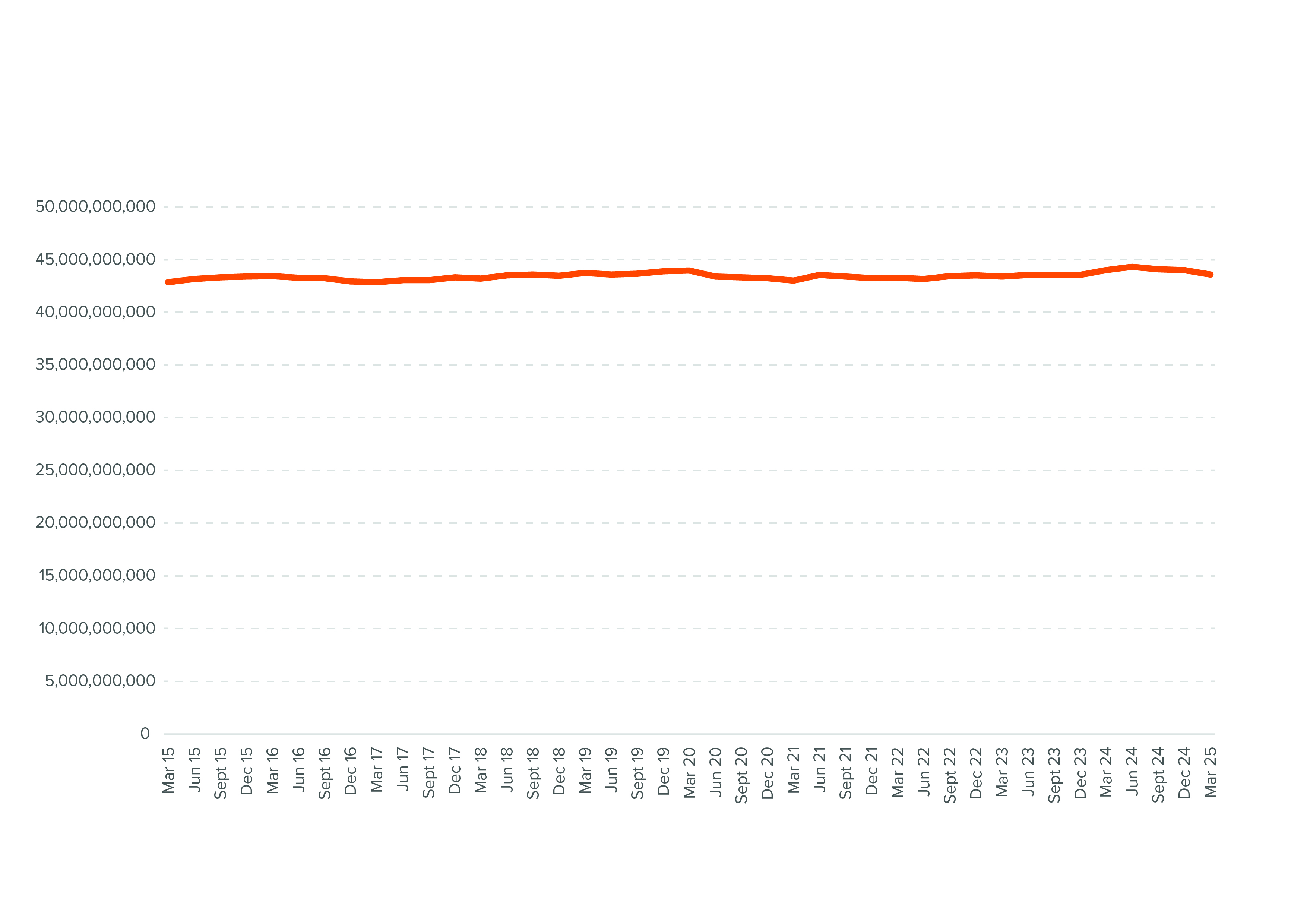
Despite these wider changes, the amount of electricity generated in New Zealand has remained almost exactly the same, at around 44,000 GWh annually. The amount generated by type - hydro, wind, solar, gas, etc - has not moved significantly during this period too.
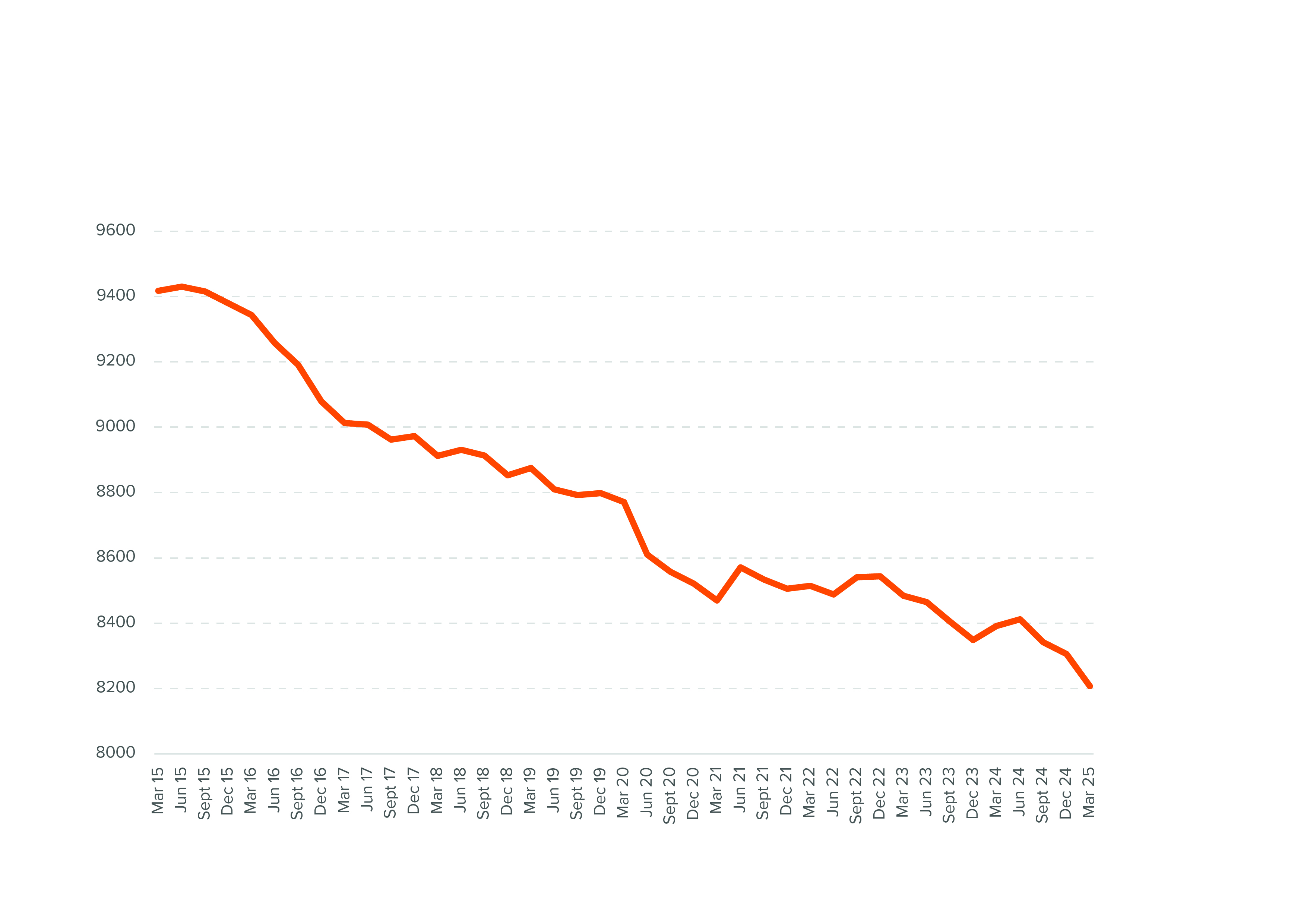
Flat generation alongside a growing population means declining electricity generation per capita, which has fallen 13% in the last decade. In Australia, generation over the last decade is stable per person at 10,400 KWh person – 22% above the rate in New Zealand. In the US, generation per person has grown over the past decade.(reference)
Figure 1: Annual Electricity generated in New Zealand (gWh)
New Zealand’s demand for electricity should be on an upwards curve. More heating is being delivered via heat pumps. More cooking is done with electricity. We have more electronic gadgets from robot vacuums to computers to air conditioning units.
An example of this growth can be found in our car fleet. In 2015, there were 845 battery electric vehicles registered in New Zealand. By 2025, that figure had risen to 83,806. This is a near 10,000% increase.
What hasn’t remained the same during this period are electricity prices, which are rising year on year. Across the past ten years, they have increased by 30% in nominal terms. Much of that increase has come in the recent past – with increases of 19% between 2021 to 2025 recorded for consumers. Electricity prices rose 11% last year – a rate faster than during the post-COVID inflation period.
Figure 2: Annual Electricity Generation per person NZ (KWh)
Energy prices are much higher here than they are in Australia. The average quarterly electricity bill in Victoria is A$305 – or NZ$335 (Finder Consumer Sentiment tracker, Sept. 2025). The average bill in Auckland is NZ$603 a quarter. If you live in Kerikeri its $807 per quarter.
Figure 3: Electricity Prices in New Zealand, index
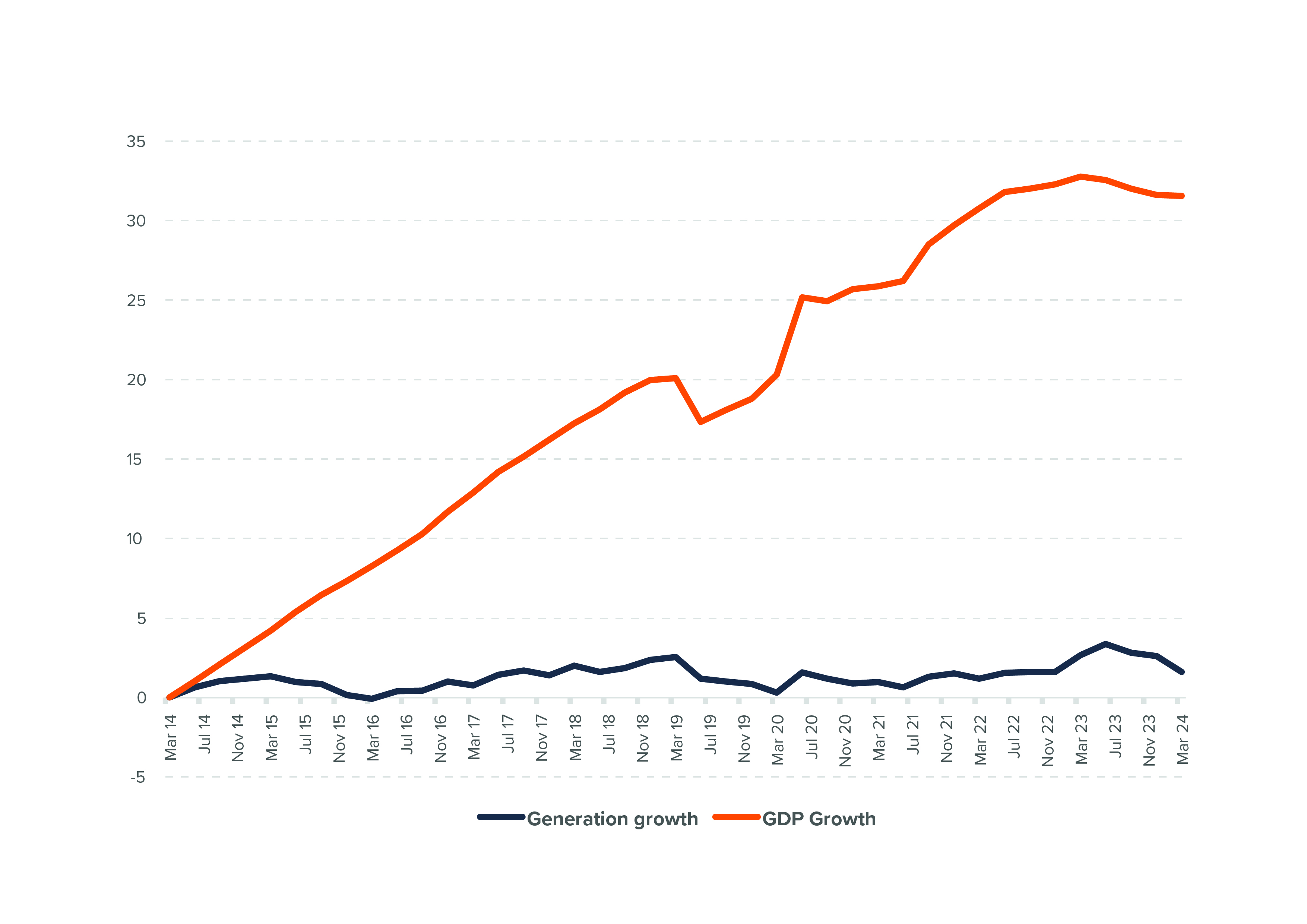
Static generation levels are also odd because the economy has grown by about 30% in real terms during the last 10 years. Electricity generation growth and GDP growth are compared in Figure 4.
Figure 4: Electricity Generation and GDP Growth over the past decade, index
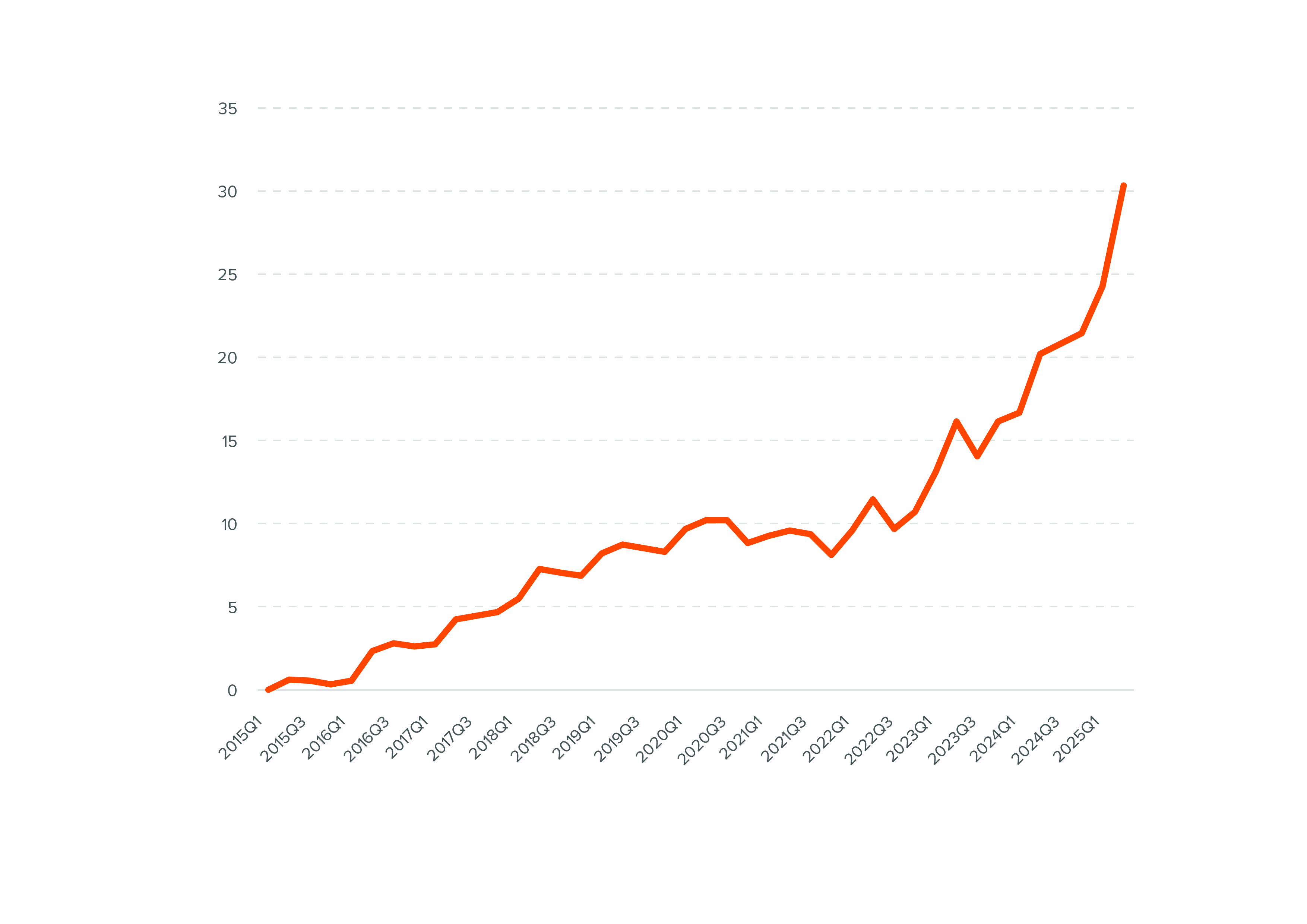
If GDP is growing, and electricity generation is static, that means that the importance of electricity as a driver of economic growth is falling. Businesses that use electrical power to drive output have either gone through a very significant increase in productivity, which has yet to show itself in the productivity statistics, or there are likely to be fewer of them.
Wood, Pulp, Paper and Printing electricity consumption has fallen significantly – by 60% over the ten years for which we have data. Electricity use by the chemicals sector has also fallen by 44%, and 13% in the basic metal sector. Electrical consumption across all industry has fallen by a little over 13% across 10 years.
Figure 5: Electricity Consumption of Selected Sectors (GWh)
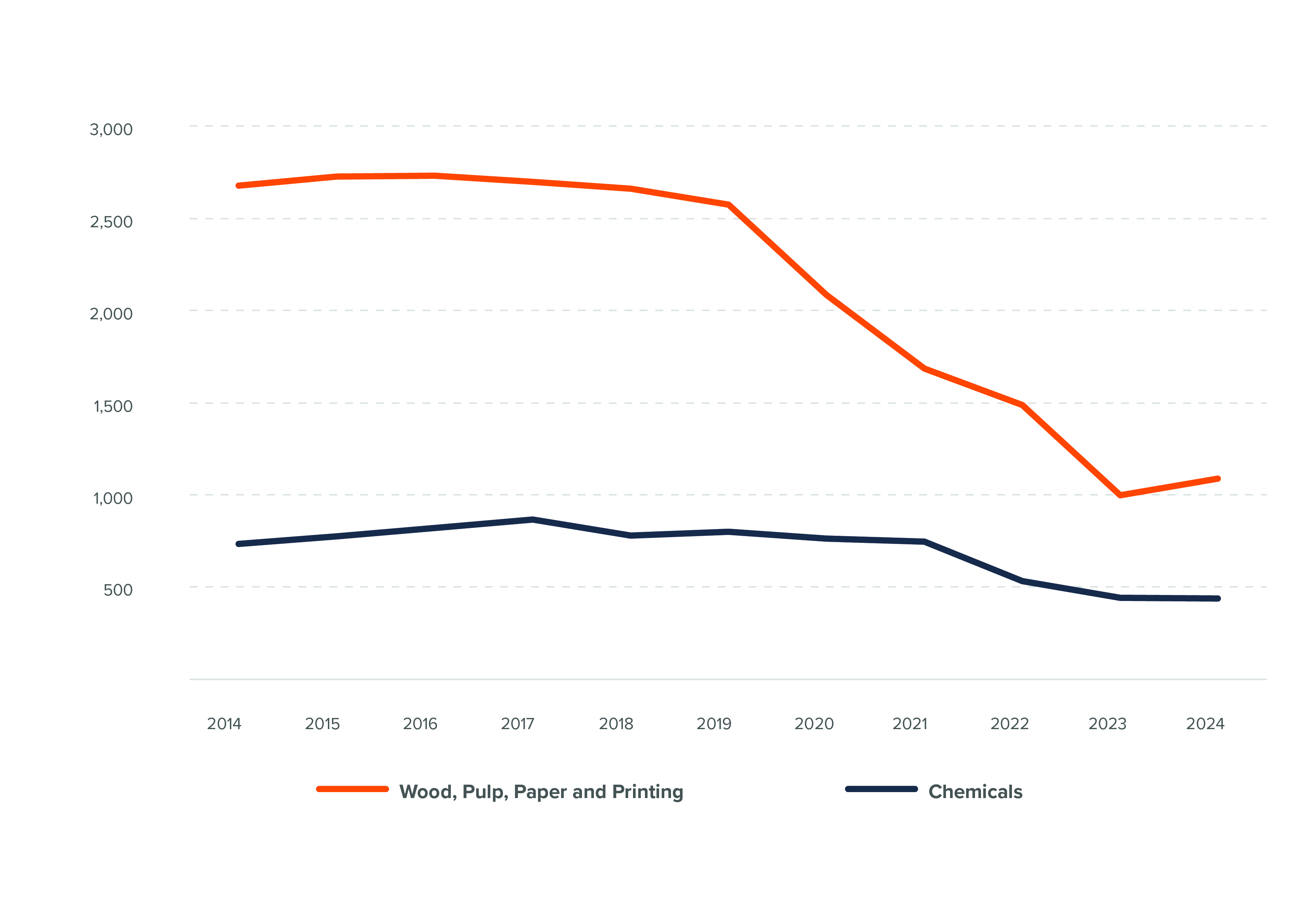
What we are seeing is the deindustrialisation of the New Zealand economy. Large energy-intensive users of electricity are leaving, citing high energy – both gas and electricity prices – as their principal driver. Examples include the Tokoroa PM6 Paper Plant, Winstone Pulp International’s two central North Island mills, and Oji Penrose. According to Karen Boyes, executive director of the Major Electricity Users Group, if reforms are not made, New Zealand faces a “risk of deindustrialisation”.(reference)
Energy hardship is also a major problem. MBIE’s first (and only) energy hardship report in June 2023 found that:
- more than 110,000 households could not afford to keep their home adequately warm
- households with Māori and Pacific peoples are more likely to experience measures of energy hardship
- renters are between 4 and 6 times more likely to experience energy hardship
- around a third of low-income households could not afford to keep their accommodation adequately warm
- crowded households are more likely to experience measures of energy hardship compared to non-crowded households.
Since 2023, the price of electricity has continued to rise. Unfortunately, our knowledge of what is happening to consumers has declined. The Government chose to end the collection of data on electricity pricing through the Electricity Authority in December 2024.
What is driving these outcomes?
This is a classic case of market failure. The market is not working for its customers or the wider economy.
The electricity market is one of the few markets that truly needs to be in balance. Not enough supply, and the lights go out. Maintaining enough supply is about finding an equilibrium between baseload (the majority of supply) and peaking (which accounts for the ups and downs in demand).
In New Zealand, four companies dominate both the generation and retailing of electricity – the “gentailers” (The government maintains 51 percent shareholdings in Genesis Energy, Meridian Energy, and Mercury. Contact Energy, the fourth gentailer, is fully privately owned). The price paid to generators for supplying electricity is driven by the cost of the last unit of supply needed by the grid. Here, that last unit of supply is often provided by the Huntly coal-fired power station – and is amongst the most expensive units of electricity. All the other suppliers to the grid get the benefit of that expensive last unit.
If suppliers provided enough electricity to the market without Huntly, they would all be worse off. If there is a peak in demand caused by a cold weather event, or by an outage in a power plant elsewhere, the price rises even more quickly. Falling gas supplies, and a lack of alternative generation delivery, have made that possibility more likely over the past couple of years.
The generators are therefore financially incentivised to continue a market where the “balance” of electricity supply and demand can be found only at a point where the market is providing expensive electricity. If any of the providers rapidly expanded their market share through new generation, they would be worse off.
This is a classic case of market failure. The market is not wrong – it’s just that the outcomes that it provides don’t work for its customers or the wider economy. Profit seeking in one market leads to value destruction and underdevelopment in other markets.
It also explains why expecting the market to solve this problem itself – with more generation – doesn’t work. In June 2025 the big four power companies moved ahead with plans to extend the life of the Huntly Power Station until 2035 – extending the period in which this perverse equilibrium exists.
Profits and dividends
We need a system that produces enough cost-effective renewable electricity to support a thriving economy and lower household living costs.
Aotearoa needs an electricity system that produces sufficient quantities of cost-effective renewable energy both to support a thriving economy and lower household living costs. In addition, we are in the midst of an energy transition that will require our electricity system to do significantly more heavy lifting as we electrify our transport and industrial sectors.
The structure of the market, as described above, means electricity providers are disincentivised to increase generation. Instead, what we have seen is excessive dividend payouts to shareholders, totaling some $13.7 billion since 2013, when the Key government sold 49 per cent of the shares of the country’s three largest electricity companies to private shareholders.
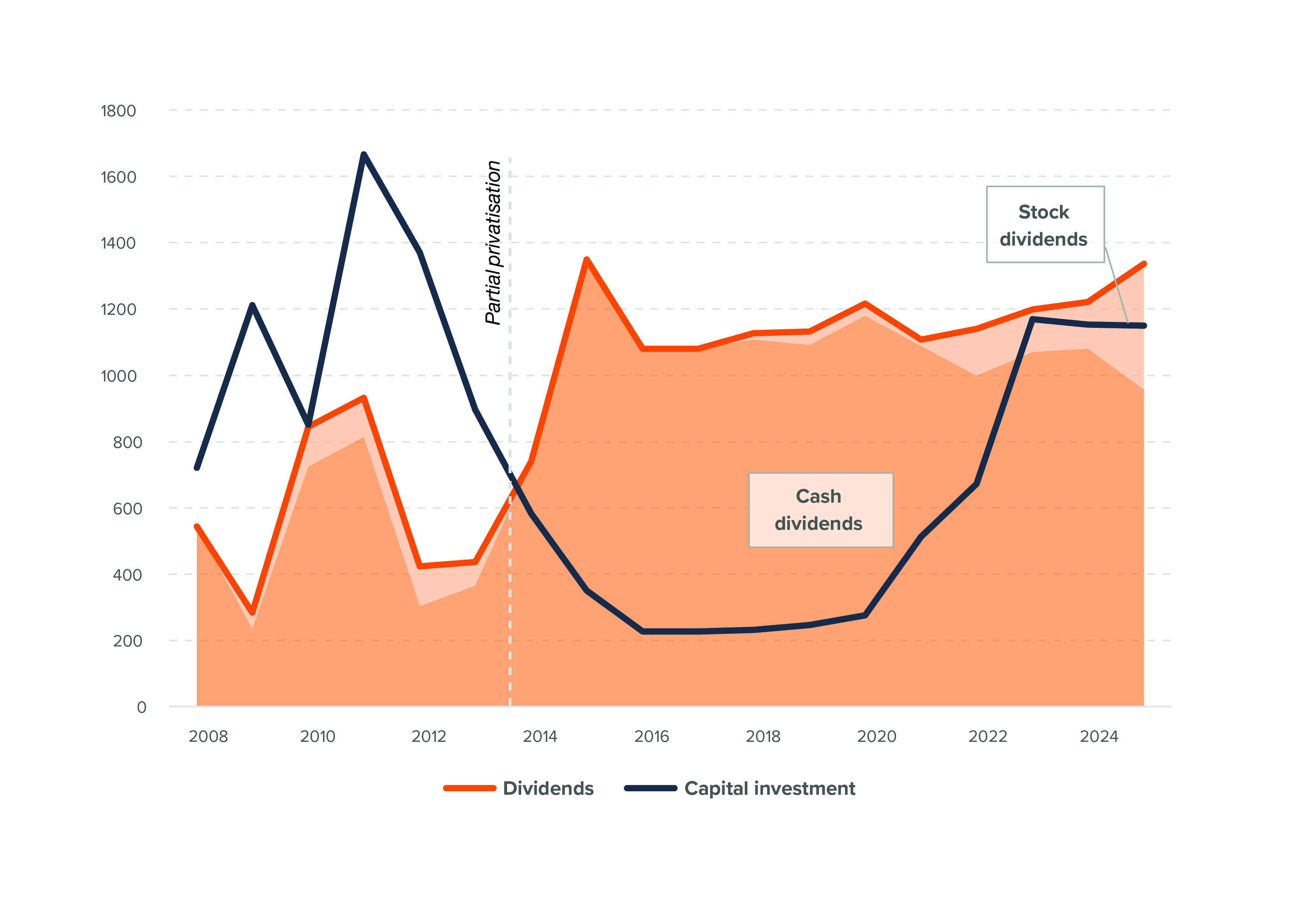
After this partial privatisation, gentailer shareholders were rewarded with windfall dividends that reached $1.35 billion in 2015, a figure roughly double the pre-privatisation average. In other words, while the quantum of dividends returned to the government has remained roughly consistent, a new income stream was opened up for private shareholders.
Gentailer dividends remained above the billion-dollar-per-annum mark for the remainder of the decade while capital investment fell dramatically, from almost $1.7 billion in 2011 to just $227 million in 2016, staying around this level for half a decade. In the five years from 2016 to 2020, just $1.2 billion was spent on capital investment, roughly equal to a single year of dividends over this period.
Combined gentailer capital investment has increased in recent years, but has never quite caught up to dividends, which again reached a combined $1.35 billion in 2025. Over the 12 years since partial privatisation (2014 to 2025), cumulative dividends total $13.73 billion ($12.82 billion in cash dividends and $900 million in stock dividends), more than double the $6.8 billion spent on capital investment over that period.
Gentailer dividends are often paid in “excess” of profits, as reported profits can be impacted by non-cash measures like changes in the value of generation or financial assets. This often means that the gentailers will distribute funds from the company to shareholders, without having first made those funds as profits – reducing the resources available for investment still further.
Figure 6: Combined gentailer dividends vs investment ($m)
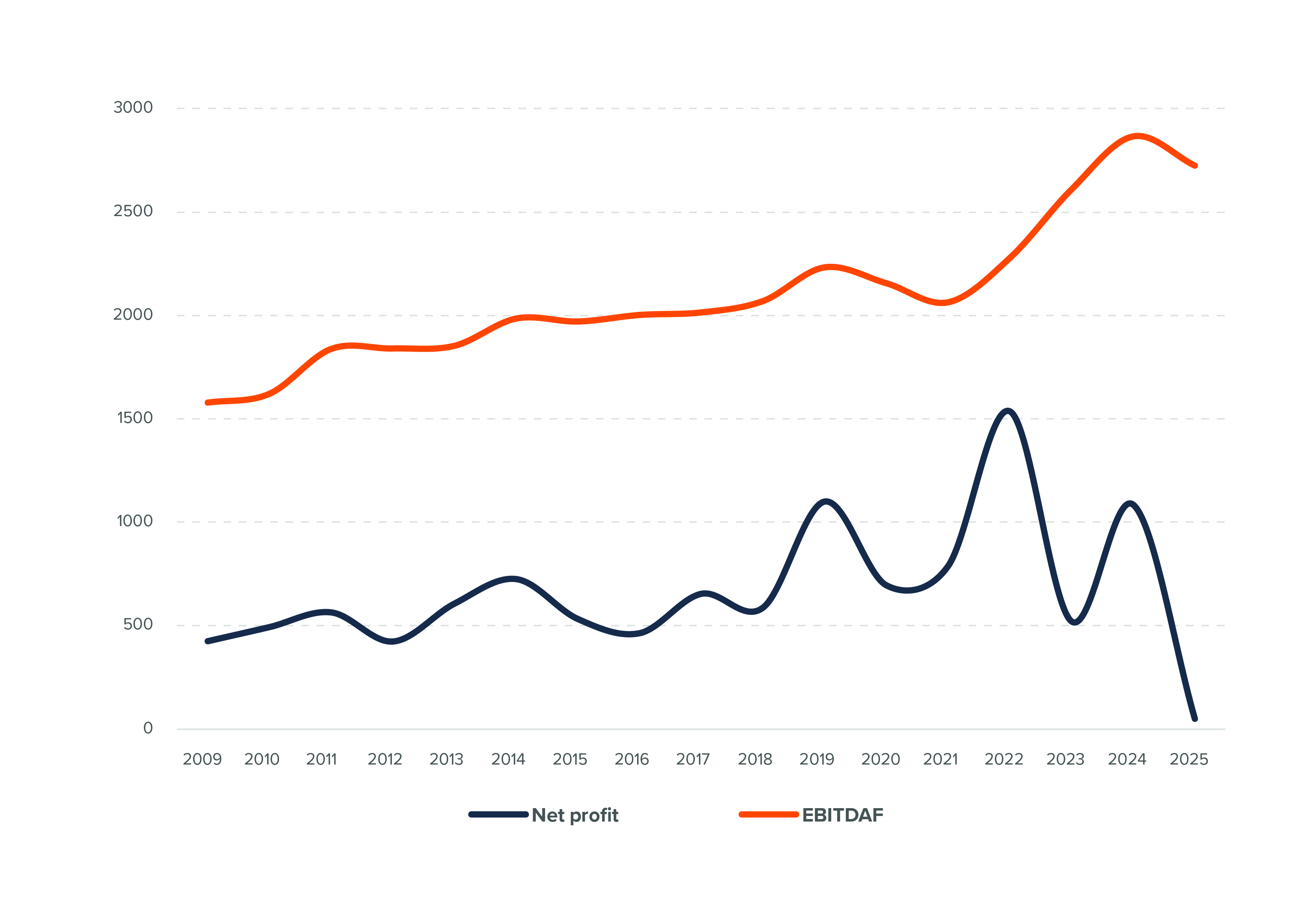
Gentailers’ combined net profit after tax fell from more than a billion dollars in 2024 to just $49 million in 2025. Contact and Genesis both enjoyed profit increases, while Mercury’s net profit fell to just $1 million and Meridian sustained a $452 million loss.
Financial statements show that Mercury and Meridian (both of which are majority state-owned) experienced a significant decline in the fair value of their hedging contracts, suggesting that these are not cash losses. While Meridian talked publicly about taking “a big financial hit” in 2025, the company still delivered $544 million in dividends to shareholders.
The sector’s preferred profitability measure of earnings before interest, tax, depreciation, amortisation and fair value adjustment (EBITDAF) reached $2.72 billion in 2025, just down on its 2024 earnings record.
The capital investment figures mentioned above likely overestimate the level of investment in new capacity that has taken place. This is because the measure includes expenditure on maintaining and upgrading existing capacity, as well as expenditure on the purchase or renovation of corporate offices and facilities.
It also does not differentiate between existing and new generating capacity. In 2024, for example, Contact announced the $1.9 billion acquisition of Manawa Energy, then the country’s (distant) fifth generator. As this is acquiring “new” generation capacity for Contact, it appears as investment on the purchaser’s books – even though there is no net new generating capacity created.
Using data provided by the three gentailers in which the Government has a stake, journalist David Williams found that spending on new renewable capacity increased by only $1.38 billion in the 11 years since partial privatisation (2014 to 2024). Over that same period these three companies distributed some $9.45 billion in dividends, almost seven times the level of investment in new renewable capacity.
The state is the largest shareholder in the sector, with 51 percent of Genesis, Mercury and Meridian shares, and therefore receives substantial dividends (both cash and shares), totaling some $5.34 billion since partial privatisation. In addition, the state also receives substantial corporate tax revenue: from the four gentailers this has totaled $2.7 billion since partial privatisation.
Figure 7: Gentailer profit and earnings ($m)
Once dividends and taxes from the generation sector are included, the total annual return for the government from the electricity sector is around a billion dollars a year, without counting taxes on profits earned in the distribution sector. The income received by the state from the electricity sector plays an important role in funding public services and infrastructure. However, it also raises questions about the impact of taking a billion dollars of potential investment out of the electricity system each year and the benefits captured by private shareholdings in these firms at the expense of the public good.
We can see the effects of underinvestment in Figure 8, in which installed capacity (the orange line) deviates from its trend over the previous 12 years (the dotted line) around 2013, the time of partial privatisation. From 2011 (when the gentailers were being readied for sale) until 2017, generating capacity actually declines before slowly starting to increase in the late 2010s. It has risen more quickly in the 2020s but remains below trend.
Figure 8: Installed Capacity (MW)
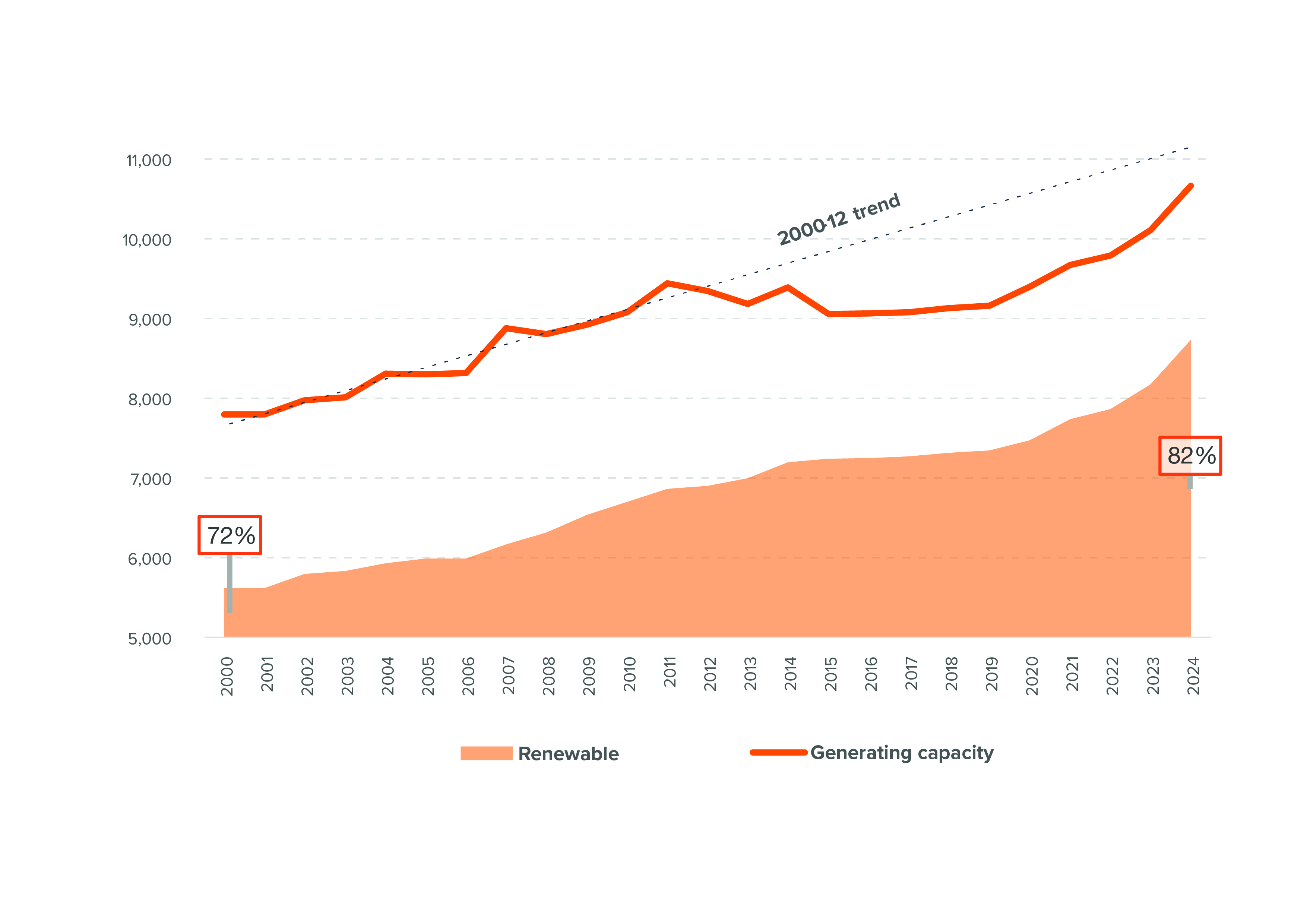
More than half of this increase occurred between 2022 and 2024, driven by increases in wind (322 MW) and solar capacity (309MW), as well as geothermal (222 MW). This increase in renewable generation isn’t just being driven by consumer expectation: onshore and offshore wind, solar power and battery storage have all experienced steep cost declines in the last decade, while fossil fuels – particularly imported fossil fuels – surged in the wake of the Russian invasion of Ukraine and have stayed high since.
The renewable share of generation has increased over this period, from 72 percent in 2000 to 82 per cent in 2024. Installed capacity is up 16 percent since 2013 to 10,661GW – an average increase of just 1.3 percent per year.
Rooftop solar is now the cheapest source of energy available in Aotearoa, partly because it doesn’t incur transmission or distribution costs, let alone gentailer profits.
A Just Transition?
With fossil fuels set to play an increasingly marginal role in the economy, it’s essential we bring on enough renewable capacity to make electricity affordable.
The impact of underinvestment became particularly clear in the dry winter of 2024, when surging electricity prices resulted in a number of large manufacturers announcing closures. Over half New Zealand’s electricity supply still comes from hydro generation, much of which was built many decades ago by the State Hydro Electric Department.
Steady hydro generation requires a steady water cycle, and ours is increasingly being disrupted by climate change. This means some years will be wetter (requiring investment to manage flooding) and some will be dryer, requiring more non-hydro renewable electricity generation. In August 2024 wholesale electricity prices quadrupled (to $800MWh) for a week, before almost completely collapsing.
Wholesale prices remained high for the first three months of 2025 as generators burned fossil fuels to conserve water in case of another dry winter. While the threat level appears to have declined, Transpower are warning of potential supply-demand imbalances by 2026 that could result in shortages, spiking prices and layoffs.
This impact has been heightened by declining production in New Zealand’s gas fields, which have historically played the backup role in our electricity system. The current Government has blamed this decline on the previous Government’s 2018 decision to ban new offshore oil and gas developments.
The reality is that our reserves of gas are drying up: the industry has spent more than a billion dollars on exploration in recent years, but recoverable reserves are now even less than we previously thought. This reflects global trends of mature offshore gas fields – like the North Sea and Gulf of Mexico – that are declining faster than previously expected.
While the Government has repealed the ban and even offered incentives, such as the $200m set aside for a stake in new oil and gas fields, the enormous declines in the cost of new renewable capacity are facilitating a rapid electrification of the economy in which fossil fuels will play an increasingly marginal role.
What needs to change
Simply expecting market forces to address a problem created by the market won’t work. Electricity should be a tool of economic development, not a profit centre.
The National–ACT coalition agreement commits to repealing the ban on offshore oil and gas exploration, cancelling the Lake Onslow Pumped Hydro project and amending the Resource Management Act to make it easier to consent new infrastructure “including renewable energy”.
The National–NZ First coalition agreement includes a commitment to “Deliver Net Zero by 2050 including by doubling New Zealand’s renewable electricity and supporting new technology to reduce agricultural emissions”, echoing some similar language in the ACT agreement. The parties also agreed to “require the electricity regulator to implement regulations such that there is sufficient electricity infrastructure to ensure security of supply and avoid excessive prices.”
Since the election we have had a dearth of actual action to deliver cost-effective electricity. Electricity costs have spiked at times, and the regulator is not delivering a competitive market.
It is clear the current approach to electricity generation and to the management of the electricity market is not working. It is causing the closure of important regional employers. It is driving thousands of families into energy poverty. Opportunities to make New Zealand a leader in carbon-free electricity are being missed.
According to MBIE forecasts, electricity demand could grow by up to 82% by 2050. Even across shorter timeframes there are challenges. Building the capacity needed over the next ten years will require “a rate of sustained generation build much greater than that achieved in recent years” according to Transpower. Yet right now (September 2025) only six electricity projects have funding and are under construction, according to the Infrastructure Commission’s Infrastructure Pipeline. Only one is costed above $25m and three are less than $1m.
The conclusion the NZCTU draws from this evidence is that the current market for electricity is not working. And the reason why it is not working is because we are treating it as a market, in which the primary objective of electricity providers is to maximise profit. Electricity should be a tool of economic development and industrial policy, not a profit centre.
Affordable electricity is increasingly out of reach for New Zealand households and energy-intensive firms, and the profit motive is the reason. New Zealand is facing a future of higher bills, and a need to tackle climate change without a credible plan from the Government.
It is clear that change needs to happen. Simply expecting market forces to address a problem created by the market won’t work. The change we need is structural.