
Introducing a New Corporate Manslaughter (Homicide) Law
Key points
- One worker dies every week on the job, and 17 more from work-related illnesses. Every single one is preventable.
- Corporations can and do kill workers. It’s time the law reflected that.
- Health and safety isn’t a barrier to productivity, it’s the foundation of it.
- We hold individuals accountable for manslaughter. Why should corporations be above the law?
- New Zealand is falling behind. Australia and the UK, which have better H&S records than New Zealand, have corporate manslaughter laws.
DOWNLOAD INTRODUCING A NEW CORPORATE MANSLAUGHTER (HOMOICIDE) LAW as PDF
New Zealand fails to protect its workers
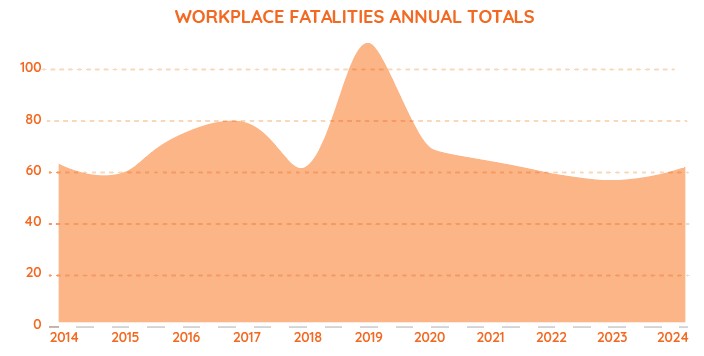
For too long the health and safety of working people in New Zealand has not been prioritised. Workers continue to sacrifice their health, and their lives, for their work. On average, one worker is killed on the job every week. A further 17 are killed each week due to work-related illnesses such as cancer.
We know that every one of these deaths is preventable; we know that good work requires workplaces that are healthy and safe; and we know productive workplaces are ones where workers aren’t being killed and injured.
This government wants to increase productivity growth. However, at the same time it has decided to undermine the workplace health and safety system, seemingly unaware of the evidence that poor health and safety has large social and economic costs, including to productivity.
Conservative estimates suggest that workplace injuries and deaths cost the economy $5.4 billion a year. However, the true cost is likely much higher, as this analysis fails to consider the social impacts on individuals, and friends and whānau of injured or killed workers.
Raising the bar for workplace health and safety | Ensuring that business governance is involved in workplace health and safety
Reimagining Aotearoa means creating good work in New Zealand, prioritising the health and safety of workers, and ensuring that health and safety is recognised as a critical element of productivity rather than being perceived as a barrier to productivity.
Tragedies such as the Pike River Mine disaster and the CTV building collapse remind the public of the tremendous impact that corporate negligence, omission, and wilful blindness have on the lives of working people. They justifiably trigger a powerful and emotionally charged public response.
Corporations can and do kill workers, which is why we need to introduce a crime of corporate manslaughter in New Zealand. Such a law would hold corporations guilty for acts of culpable killing and give the public confidence that corporations and their managing individuals will be held to account for acts of corporate manslaughter.
It would deter wrongful conduct on the part of corporations and would mark a paradigm shift in how health and safety obligations are viewed and enforced at every level. It would ensure that the most extreme breaches of health and safety duties result in a high level of criminal liability.
Critically, a corporate manslaughter law sends a significant message to PCBUs (Person Conducting a Business or Undertaking) and the officers of those PCBUs to comply with all their health and safety obligations. This will reinforce that the health of workers is not something that sits on the balance sheet but is core work of every business.
International Comparisons
Compared to some of our peer countries, New Zealand stands out for not having a corporate manslaughter law.
|
Jurisdiction |
Maximum Penalty (Body Corporate) | Maximum Penalty (Individual) | Fault Element (Aggravating Factor) |
| Australian Capital Territory | A$15 million fine | PCBU or officer; 20 years imprisonment | “reckless or negligent about causing the death” |
| Commonwealth Government | A$18 million fine | PCBU or officer; 25 years imprisonment | “reckless or negligent, as to whether the conduct would cause the event” |
| Northern Territory | A$10 million fine | PCBU or officer; Life imprisonment | “reckless or negligent about the conduct” |
| Queensland | A$15 million fine | PCBU or officer; 20 years imprisonment | “negligence” |
| Victoria | A$19 million fine | PCBU or officer; 25 years imprisonment | “negligence” |
| South Australia | A$18 million fine | PCBU or officer; 20 years imprisonment | “gross negligence or is reckless” |
| Western Australia | A$10 million fine | PCBU or officer; 20 years imprisonment and/or fine up to A$5,000,000 | “knowing that the conduct is likely to cause the death of, or serious harm to, an individual, and in disregard of that likelihood” |
| New South Wales | A$20 million fine | PCBU or officer; 25 years imprisonment | “gross negligence” |
| United Kingdom | £20 million fine | Employer or director | “gross breach of a relevant duty of care owed by the organisation to the deceased” |
Source: Belich, C. (2024). Why Aotearoa New Zealand Needs a Corporate Homicide Bill. New Zealand Journal of Health and Safety Practice, 1(2).
Draft legislation
The basis of the required law change has been drafted and sits in the Parliament biscuit tin in the form of Adrian Rurawhe’s Member’s Bill the ‘Crimes (Corporate Homicide) Amendment Bill’.
Reimagining Aotearoa Together recommendation
The Crimes (Corporate Homicide) Amendment Bill is passed as soon as possible by a new progressive government.