

A New Deal for Workers
WE NEED AN ENDURING EMPLOYMENT RELATIONS FRAMEWORK THAT SUPPORTS GOOD WORK, HIGH WAGES, AND PRODUCTIVITY.
Over the past 35 years, attacks on labour rights and standards have suppressed wages, increased inequality, and left many New Zealanders working longer hours on lower pay and with less agency in the workplace.
While collective bargaining is recognised as a fundamental workplace right that reduces power imbalances between employer and employee, supports higher wages, and lifts productivity, Aotearoa New Zealand’s employment relations system is not fully supportive of collective bargaining. This means that, outside of a small number of union-dense industries, employers effectively determine wage rates unilaterally and real bargaining does not occur.
If we want a productive economy that has good, well-paid jobs in growing industries, we need to establish an enduring employment relations framework that supports and aligns with global labour rights principles. Trade unions need to be enabled to participate fully and effectively in workplaces, in collective bargaining, in industry dialogue, and in the wider economy as a social partner within a democratic society.
To achieve this, the NZCTU proposes three key amendments to the employment relations framework:
- Establish a mechanism for setting minimum employment standards at the industry level. This will ensure higher wages and better standards across those industries that are locked into a low-wage equilibrium. Fair Pay Agreements remain the answer.
- Simplify the processes for new employees to join their union. By making it easier for workers to access their union at the beginning of an employment relationship, we can support collective bargaining, higher wages, and enabling good faith employment relationships.
- Clarify the law to ensure that workers who, by the real nature of their employment, are employees are not misclassified as contractors. This will ensure that misclassification is not used to drive down terms and conditions for workers in precarious occupations.
DOWNLOAD "A NEW DEAL FOR WORKERS"
THE BENEFITS OF TRADE UNIONS AND COLLECTIVE BARGAINING
COLLECTIVE BARGAINING PROTECTS WORKERS’ RIGHTS, ENABLES INCLUSIVE WORKFORCES, ADDRESSES EMERGING ISSUES, AND CREATES FAIRER SOCIETIES.
A collective agreement is a formal employment agreement signed by a trade union and an employer that covers the terms of employment such as wages, working conditions, health and safety, training, and other benefits for members of the union. Collective agreements are negotiated between one or more trade unions and one or more employers in a process called
collective bargaining.
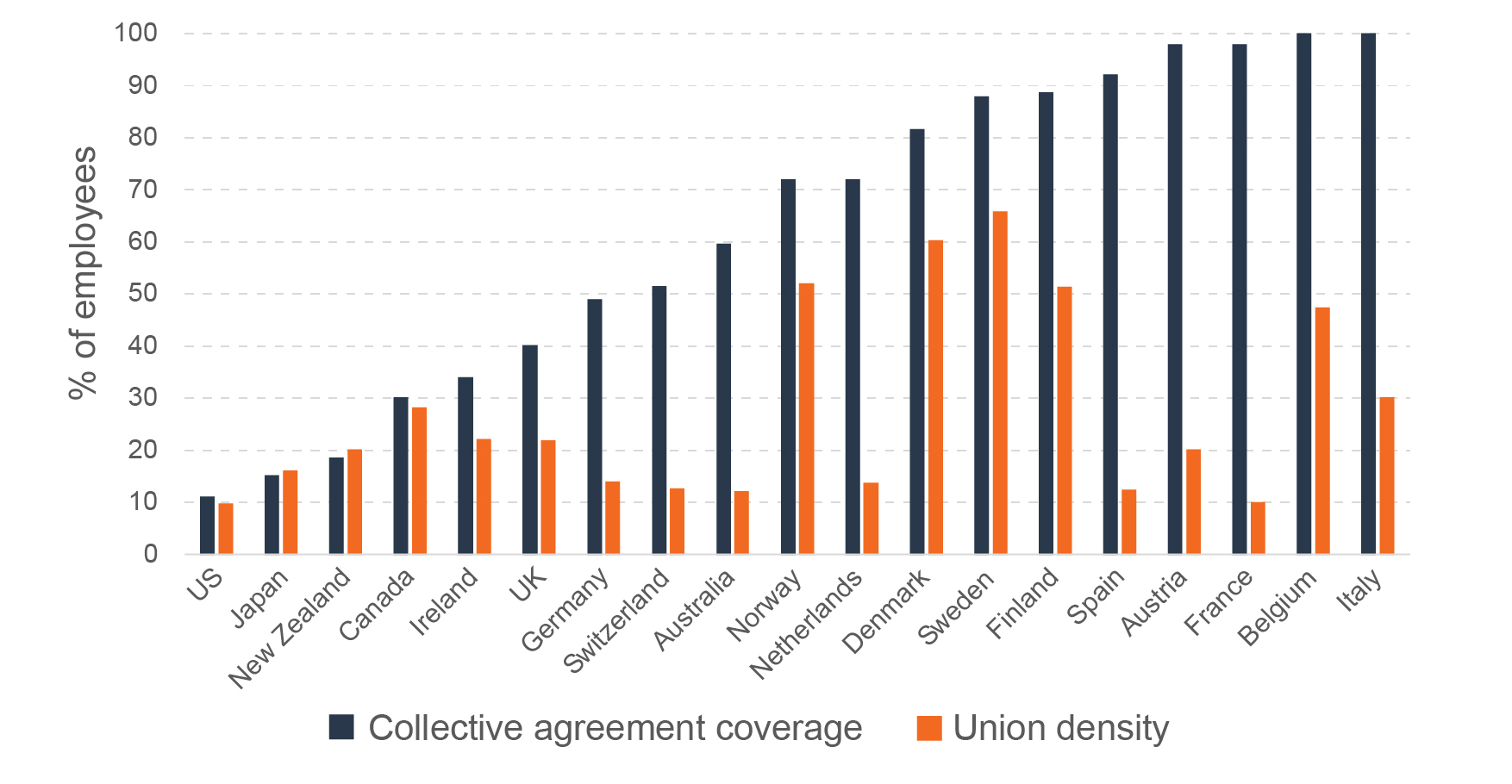
Internationally, the right to collective bargaining is considered a fundamental principle and right at work. Collective bargaining helps to reduce the power imbalance inherent in the employer–employee relationship by enabling workers to use their collective strength to influence the terms and conditions of their employment. Higher trade union density and collective agreement coverage is associated with higher wages and a more even distribution of incomes.
FIGURE 1: THE SCOPE OF COLLECTIVE AGREEMENTS

Collective bargaining is also associated with improved productivity. A recent study of 26 European economies found that the “likelihood of productivity increases is significantly (and robustly) higher for workplaces, which fall under a collective agreement”.1 Similarly, the OECD has found that “collective bargaining can improve the quality of the employment relationship between workers and firms. It can be a useful tool for self-regulation between workers and employers and bring more stable labour relations and industrial peace, leading to a more efficient allocation of resources, greater motivation and ultimately productivity”.2
New Zealand has long struggled to lift labour productivity, and this is widely acknowledged to be an important reason for slower GDP growth than many other wealthy countries. The data shows that countries with higher levels of collective agreement coverage than New Zealand often have higher levels of labour productivity, as shown in Table 1. Our relative lack of collective agreement coverage is likely contributing to our low labour productivity.
Collective bargaining also plays a role in minimising other economic and social inequities. For example, collective bargaining can help to narrow gender and ethnic pay gaps by securing equitable pay rates, flexible work arrangements, and improved parental and family leave.
Collective bargaining and trade union density are strongly associated with safer and healthier workplaces, meaning fewer injuries and fatalities (the “union safety effect”). Collective bargaining also supports stronger redundancy protections and management-of-change procedures.
TABLE 1: COLLECTIVE BARGAINING COVERAGE AND LABOUR PRODUCTIVITY, SELECTED HIGHINCOME COUNTRIES
| Country | Covered by collective bargaining (%), 2024 or latest available | GDP per hour worked in current prices and current PPPs (US$), 2023 |
| Belgium | 100 | $100.33 |
| Italy | 100 | $77.09 |
| France | 98 | $87.30 |
| Austria | 98 | $94.11 |
| Spain | 92 | $73.42 |
| Finland | 89 | $83.01 |
| Sweden | 88 | $89.60 |
| Portugal | 83 | $55.69 |
| Denmark | 82 | $99.24 |
| Netherlands | 72 | $92.89 |
| Norway | 72 | $132.28 |
| Germany | 49 | $93.72 |
| New Zealand | 19 | $55.42 |
Source: OECD; Statistics NZ. Collective bargaining coverage is the percentage of employees covered by a collective agreement of those who have the right to collectively bargain. In some countries, such as Italy, estimates of collective bargaining coverage are likely overstated due to high levels of non-compliance. PPPs is purchasing power parities.
HISTORICAL CONTEXT
WHILE LABOUR RIGHTS ARE ERODED, INEQUALITY AND THE COST OF LIVING CONTINUE TO INCREASE.
Aotearoa was once at the forefront of labour rights. The Industrial Conciliation and Arbitration Act 1894 was considered a groundbreaking system for maintaining harmonious industrial relations. Labour Day has been celebrated across the motu since 1890, and as a statutory holiday since 1900.
New Zealand played an important role in founding the International Labour Organization, the United Nations agency mandated to advance social and economic justice by setting international labour standards. The International Labour Organization standards play a central role in international employment law and in global trade agreements.
The award system of collective bargaining became a central feature of the industrial relations system in New Zealand and, despite amendments along the way, remained in place until 1991. The award system established, through negotiation and arbitration, minimum terms and conditions of employment across the economy for occupational and industry groupings. Secondary bargaining evolved over time to supplement the award system.
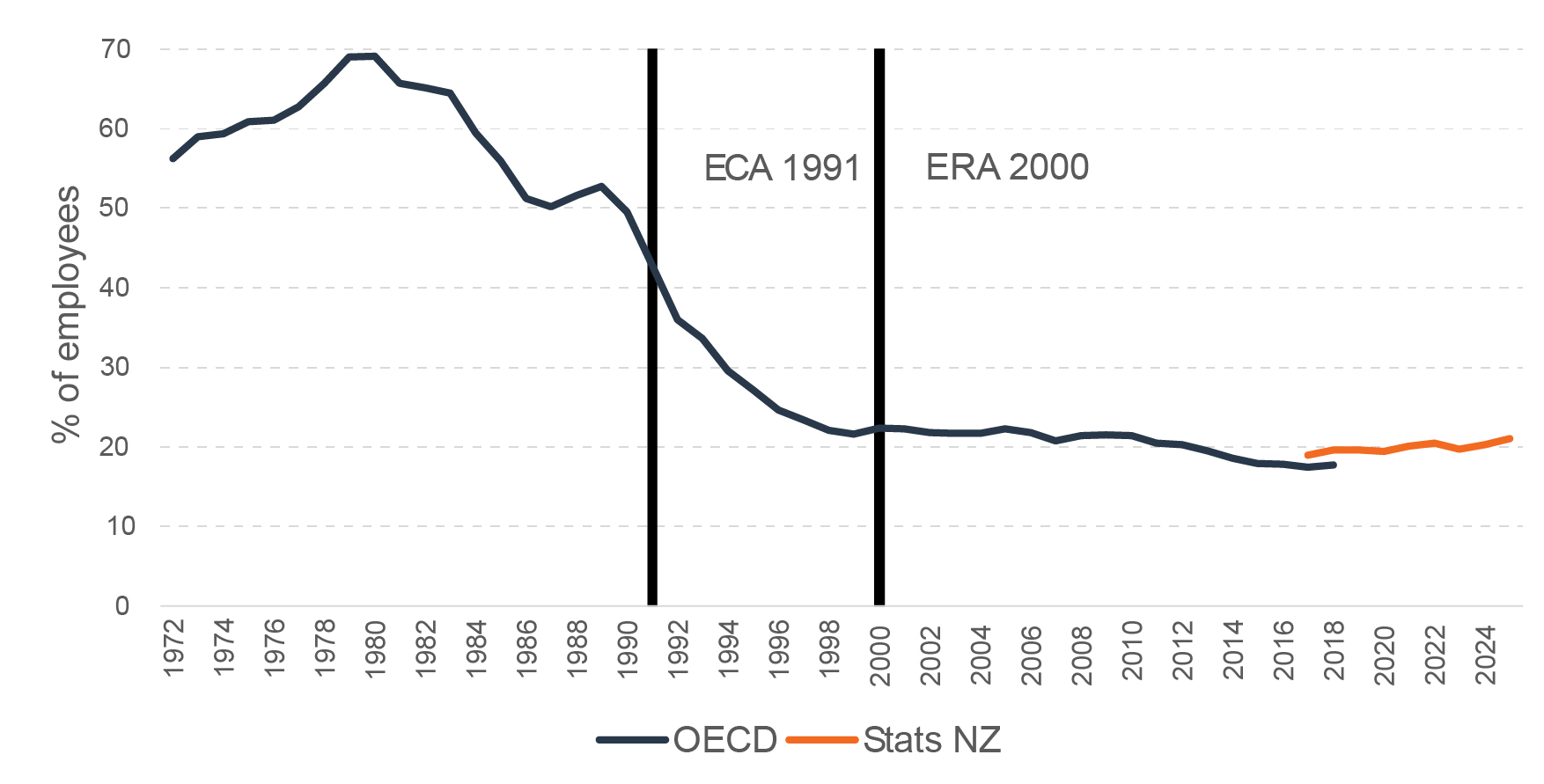
FIGURE 2: ESTIMATED UNION DENSITY IN NEW ZEALAND, 1972–2025
Source: OECD, Statistics New Zealand. NZCTU calculations.
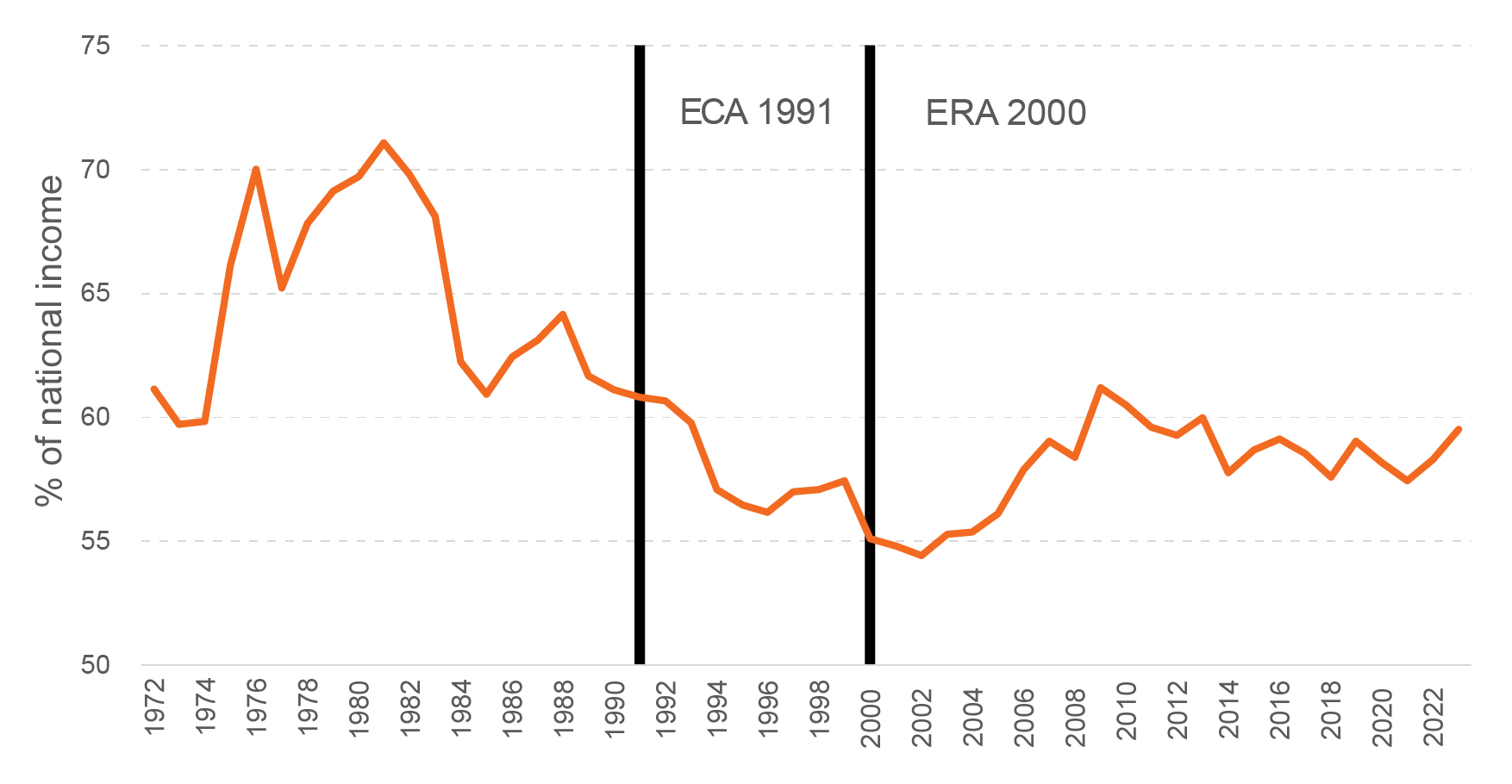
FIGURE 3: LABOUR SHARE OF NET DOMESTIC INCOME, 1972–2023
Source: Statistics New Zealand. NZCTU calculations.
The introduction of the Employment Contracts Act in 1991 marked a turning point in New Zealand employment relations. Since 1991, the legislative provisions for workplace relations have been subject to strong political preferences, particularly from National-led governments with the support of the business community. These political preferences reflect a determination to inhibit trade union presence and influence, rather than to advance worker rights principles.
The introduction of the Employment Contracts Act had a drastic and detrimental impact on unions. Industry-wide awards were cancelled at the stroke of a pen, and individual employment contracts were encouraged in their place. Unions lost their legal status, and the right to strike became more limited, as did union access to workers.
This caused a collapse in union membership, which fell by around 50% in less than a decade, and a corresponding collapse in collective bargaining coverage and union influence. Whole industries, especially in the private sector, lost union coverage, while others saw union density reduce to a fraction of pre-Employment Contracts Act levels. Economic research has established the early 1990s as an important turning point in New Zealand industrial relations, tilting the balance of power firmly in favour of capital and instituting a long period of wage suppression.3
CURRENT STATE OF EMPLOYMENT RELATIONS
SIGNIFICANT CHANGES IN EMPLOYMENT RELATIONS HAVE REDUCED WORKERS’ ABILITY TO NEGOTIATE THEIR TERMS AND CONDITIONS OF EMPLOYMENT.
Important legislative advances have been made intermittently during periods of Labour-led governments, such as with the introduction of the Employment Relations Act 2000 and the Fair Pay Agreements Act 2022. However, the Employment Relations Act only partially addressed the problems inherent in the Employment Contracts Act, and the Fair Pay Agreements Act was repealed by the coalition Government after it had only been in force for less than one year.
This means that, outside of pockets of high-density union workplaces, employers effectively determine wage rates unilaterally and real bargaining does not occur. It also means that, in practice, most New Zealand workers are unable to exercise their right to freedom of association by joining a trade union. Creating a union may be theoretically possible, but in practice extremely difficult given the lack of industry-wide collective bargaining and employer hostility.
As it stands New Zealand’s employment relations framework is set by the Employment Relations Act, which was first introduced in 2000 and has been amended several times since. The objects of the Employment Relations Act include:
(a) to build productive employment relationships through the promotion of good faith in all aspects of the employment environment and of the employment relationship—
(i) by recognising that employment relationships must be built not only on the implied mutual obligations of trust and confidence, but also on a legislative requirement for good faith behaviour; and
(ii) by acknowledging and addressing the inherent inequality of power in employment relationships; and
(iii) by promoting collective bargaining; and (iv) by protecting the integrity of individual choice; and
(v) by promoting mediation as the primary problem-solving mechanism other than for enforcing employment standards; and
(vi) by reducing the need for judicial intervention;
While these objectives remain fit for purpose, in many instances the Act’s provisions do not match these objectives.
The current Government’s approach is making it even harder to achieve these objectives. The Minister for Workplace Relations and Safety has wasted no time in dismantling workers’ collective and individual rights since taking office in 2023. The Fair Pay Agreements Act was repealed, and 90- day trials were reinstated across the entire workforce, both under urgency. Pay equity legislation has been demolished, the rights of workers to undertake partial strike action has been undermined, and further attacks are being progressed under the Employment Relations Amendment Bill and impending changes to workplace health and safety law.
FIGURE 4: COLLECTIVE BARGAINING COVERAGE AND UNION DENSITY, SELECTED HIGH-INCOME COUNTRIES, 2024 OR LATEST AVAILABLE
Source: Statistics New Zealand. NZCTU calculations.
WHAT NEEDS TO CHANGE
ESTABLISHING AN EMPLOYMENT RELATIONS FRAMEWORK THAT DELIVERS GOOD WORK, AND BETTER WAGES AND WORKING CONDITIONS IS CRUCIAL TO SUPPORT A FAIRER AND MORE PRODUCTIVE NEW ZEALAND.
We need to create an enduring legislative framework that enables workers to build effective and influential trade unions that engage in collective bargaining and social dialogue. By achieving this, we can ensure workers have a say, get their fair share, and enjoy the support of legal protections that are part and parcel of a functioning and productive modern democracy.
Establishing a system that is truly consistent with the objects of the Employment Relations Act and the conventions of the International Labour Organisation will enable extensive collective bargaining and it’s associated benefits. This will involve establishing a strong legislative framework as a foundation, along with building and encouraging an employment relations culture that respects workers and their unions.
To achieve this, we propose three reforms:
1: INDUSTRY-WIDE STANDARD SETTING THROUGH FAIR PAY AGREEMENTS
With the removal of Fair Pay Agreements, New Zealand workers and their unions, and employers and employer groups, are deprived of any effective mechanism for establishing industry-wide minimum standards. This creates an environment in which employers are incentivised to compete on cost by driving down the terms and conditions of employment for workers. Employers who pay more are disadvantaged, and this traps industries in a low-wage spiral.
This lack of industry-wide standard setting remains a significant gap in the New Zealand employment relations system. This can be rectified by the urgent restoration of the Fair Pay Agreement system to enable social dialogue on the setting of better standards across industries.
The NZCTU proposes that a restored Fair Pay Agreements Bill is introduced and enacted as an absolute priority. Additionally, it must provide:
- A clear statutory purpose that states that FPAs must be created to improve the conditions of those who are covered by its terms.
- Tighter provisions and stronger procedural certainty to ensure that parties do not engage in time wasting and FPAs are settled in a timely fashion.
- Two paid stop work meetings for workers covered by an FPA to formulate and ratify a new FPA – taking place either during work time, or, if not released from work, in a worker’s own time which is paid.
- That a failure of bargaining will not frustrate the creation of an FPA, with effective fixing mechanisms being available and accessible to assist in establishing FPAs.
2: ACCESS TO UNIONS WHEN STARTING WORK
The 30-day rule has been an important protection for new employees, and for their representative unions. It ensures that, in a workplace where a collective agreement is operative, new employees are employed on the existing collective agreement terms and conditions and are provided with information regarding unions; in turn, unions are given the names of new employees within coverage, so that they can contact them.
To maintain these important protections for new workers, and to simplify the process, the NZCTU proposes two key amendments to the Employment Relations Act:
- All newly employed workers whose job comes within the coverage of an existing or expired collective agreement are automatically covered by the collective agreement’s terms and conditions; and automatically become members of the union, unless they opt out of doing so.
- All information regarding union and employee details are provided to the relevant parties.
These changes will enable workers to access their right to representation through their union and help protect workers from undue pressure from the employer regarding the decision to join their union and accept different conditions of employment.
These changes would also align new employee processes with the purposes of the Employment Relations Act by addressing the inherent imbalance of power in employment relationships, promoting collective bargaining and maintaining the integrity of individual choice.
This policy has broad public support. A 2018 survey indicated 59% of New Zealand adults supported introducing a union default. Likewise, a 2020 survey indicated 65% of employees said they would remain union members if automatically enrolled.4
3. SAFEGUARDING THE RIGHTS OF EMPLOYEES AND CONTRACTORS
Workers who are contractors differ from employees. As they are self-employed, they do not have access to many of the rights afforded to employees and they are required to internalise business cost such as ACC levies, leave, and management of health and safety risks. In a true contracting model, the benefits to contractors are the ability to set the scope of their work, including how, when, and where they work, and can further subcontract their work. Contractors are able to build the value of their business and realise profit from selling it.
Across some parts of the labour market, shamcontracting arrangements are being used to undermine employment practices, to undercut wages and other terms and conditions, and to force the cost of doing business onto workers themselves. In some instances, this results in workers being remunerated at less than the minimum wage and being forced into very long hours of work, with inadequate breaks. This is particularly evident in the platform and gig economies.
This practice is contrary to the objectives of the Employment Relations Act, and to broader economic and labour market objectives. It pushes the balance of power further in favour of the employer, undermining good work and the possibility of good faith in the employment relationship.
The solution to this problem requires a legislative response, which clarifies how employees and contractors are defined, who bears responsibility for the classification, and how workers can seek a determination as to the real nature of their employment status.
This work has already been completed by the Tripartite Working Group on Better Protections for Contractors, in their December 2021 report.5 The NZCTU agrees with the proposal of the working group that the “real nature” test at section 6 of the Employment Relations Act be simplified. The specifics are set out below:
| A PERSON WHO IS GENUINELY IN BUSINESS ON THEIR OWN ACCOUNT WILL DEMONSTRABLY: |
BY CONTRAST, AN EMPLOYEE WILL TYPICALLY: |
|
Be responsible for managing their |
Have a limited ability to influence the overall productivity of a business operation, other than by increasing personal efficiency or effort |
| Be free to contract with other businesses to provide the same or similar services, and build and maintain a varied client base |
Be identified as “part of” the hiring entity’s operation, and consequently have limitations on their ability to work for other organisations |
| Generate gains that accrue to their own business enterprise (e.g. an expanded client base, good will) |
Not accrue business gains of their own (any gains that could be reflected on a business’s “balance sheet” accrue to the hiring entity) |
| Have business resources available to assist in providing services (these business resources may be supplemented with resources provided by the hiring entity in some circumstances, where this is necessary to perform the services required under the contract). |
Not be required to provide significant resources to enable the work to be carried out |
To provide a clearer statutory basis for protecting workers against wrongful misclassification of their employment, the NZCTU proposes that:
- Section 6 of the Employment Relations Act is amended to simplify and strengthen the “real nature” of employment test as set out above.
- All workers have a corresponding statutory right to challenge the determination of their employment classification in the Employment Courts.
- The Employment Relations Act is amended to establish that workers are presumed to be employees by default. The burden of proving otherwise should be placed on the hiring entity.
- Judicial determinations on employment status are allowed to cover other workers performing similar work or under similar contractual terms.
- The Minister be given the ability to deem certain categories of vulnerable workers as employees.
CONCLUSION
There is now an opportunity to build an enduring legislative framework for employment relations in Aotearoa that truly promotes collective bargaining, fairly classifies workers and establishes industry standards. An urgent and immediate reintroduction of the Fair Pay Agreements Act and amendments to the Employment Relations Act will provide a legislative foundation for a new deal for workers.
There is more to do beyond this policy to ensure equal pay, health and safety and to reverse the ongoing attacks made by the current government. More detail will be released in further policy announcements.
The NZCTU will be putting this policy proposal in front of political parties and encouraging support and commitment to these changes. Anything less than full support will leave workers in Aotearoa short of what they deserve.
