
A Legislative Right to Switch-Off
New Zealand workers are constantly on the job
The way of working has rapidly changed in recent history. Increased utilisation of remote working, new digital technologies, and the growth of artificial intelligence has created never before seen expectations of connectivity and accessibility to work.
Key points
- Work is now 24/7: Tech and remote work have erased the line between work and home.
- Unpaid overtime is on the rise: We’re working long hours and much of it unpaid.
- Burnout is widespread:
Many workers report stress, anxiety and exhaustion. - The law hasn’t kept up:
Current rules don’t protect workers’ time or wellbeing. - A Right to Disconnect works: Other countries are cutting burnout and unpaid work, we should too.
Download "A Legislative Right to Switch-Off" PDF
The reality of this for workers is the constant blurring of the line between work and non-work time, intensification of work, and concerns about increased surveillance and data sovereignty outside of their work time. The impact on workers is a rising incidence in workplace health and safety issues, both physical and mental, arising from psychosocial harm such as stress, anxiety, and burnout.
Long hours of work, and overtime are already commonplace for Kiwi workers. Internationally, New Zealand works longer hours than many OECD countries.
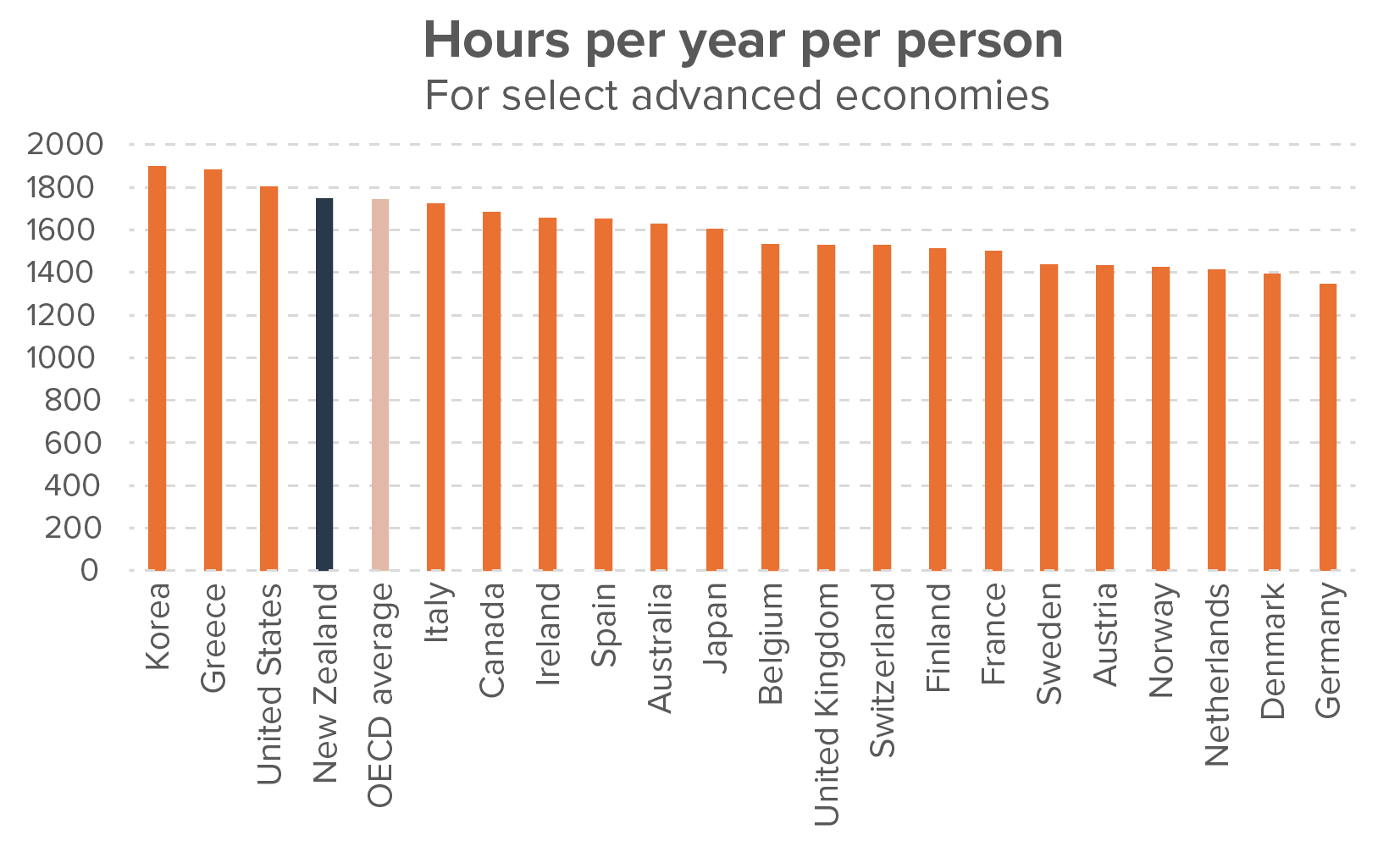
And many workers are finding that the demands of their work continue to grow both on work time and non-work time. For instance, the Aotearoa Legal Worker Union’s “New Zealand Industry Employment Report 2022-2023” found that the average amount of overtime worked had jumped 25% since 2021, with the vast majority of this overtime being unpaid.
It’s not surprising that workers are reporting that burnout and stress is on the rise:
“In 2022, 53% of New Zealand employees reported feeling burnt out. In 2024, that number has jumped to 61%.
“83% of Kiwis are experiencing stress at least a few times a month or more. Alarmingly, 43% of New Zealanders indicated that they feel stressed at work a few days a week in the last 3 months, followed by 29% indicating they feel stressed a few days a month.” (Wellness at Work 2024 report Employment Hero)
The connection between long-hours of work, and the impact of an ‘always on’ work culture has on the health and safety of workers is well researched. For instance, one study found that employees who have supervisors expecting them to respond to work messages after work, compared to groups who did not, reported higher levels of psychological distress (70.4% compared to 45.2%) and emotional exhaustion (63.5% compared to 35.2%). They also reported physical health symptoms, such as headaches and back pain (22.1% compared to 11.5%).
And WorkSafe segmentation data confirms that many workers are reporting issues relating to psychosocial risks:
Psychosocial risks experienced by New Zealand Workers
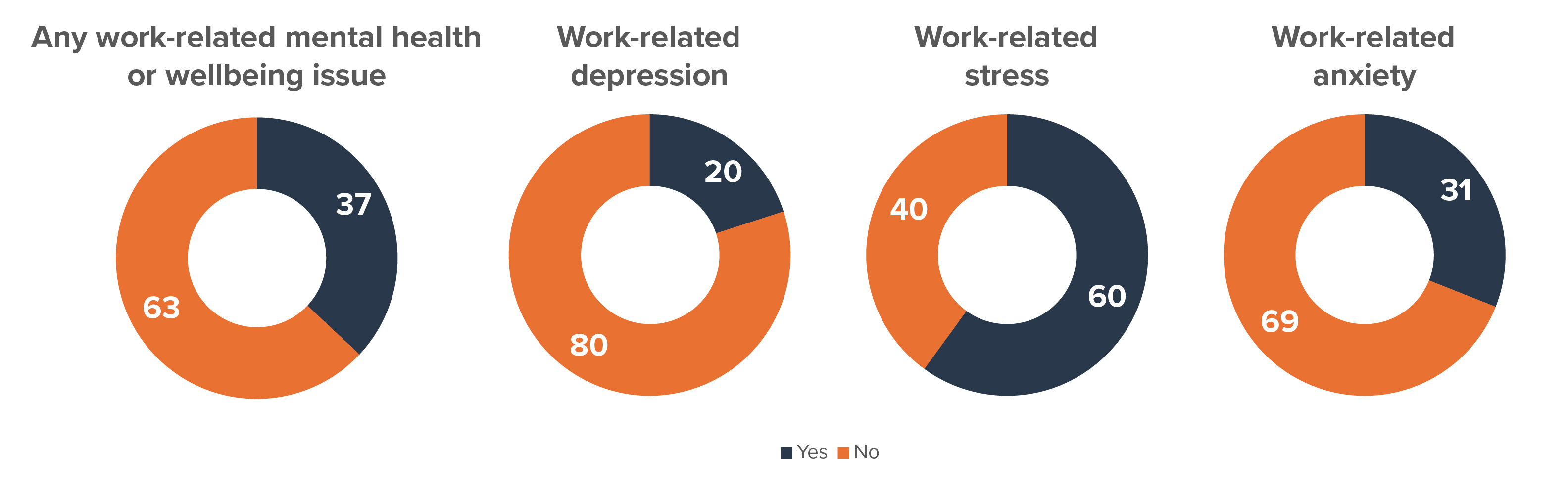
Source: WorkSafe New Zealand Mahi Haumaru Aotearoa
A right-to-disconnect law is critically necessary to address the growing crisis of illness and injuries in the workplace.
New Zealand’s laws have not kept up with the demands of work on personal time.
The only law in New Zealand that specifically concerns working hours is the Minimum Wage Act which limits working time to 40 hours a week unless otherwise agreed. New Zealand privacy laws are limited in providing workers protection from intrusive data collection, and no specific privacy laws exist in the context of employment.
Health and safety laws prescribe a duty on workplaces to do everything reasonably practicable to eliminate the risks of harm (which includes the mental and physical harm from psychosocial harm). But this is not well understood in New Zealand, and incoming changes from this government are seeking to minimise its importance. Minister for Workplace Relations and Safety Brooke van Velden has gone as far as to specifically state that SMEs won’t need to have a psychosocial harm policy under these incoming changes.
Globally, many countries are front footing the issue of work creep by adopting strong ‘right to disconnect’ laws. France, Ireland, and Germany have done so in the last decade, and recently Australia introduced such a law in its ‘Closing Loopholes” Act.
A “Right to Disconnect” law for New Zealand.
The Australian right to disconnect law provides a strong basis for a New Zealand law. It focuses on limiting the time when employers can actively contact workers (outside of agreed contractual arrangements) by giving workers a right to not be unreasonably contacted outside of work hours. This law brings balance back into worker’s lives and empowers them to decide whether to respond to out-of-hours contact, based on the reason for the contact. It strengthens the law that workers must be paid for all the work they do.
Research from the Australia Institute’s Centre for Future Work indicates that unpaid overtime hours were fewer in 2024 than in previous years, following the Australian Right to Disconnect law coming into force.
A right to disconnect law for New Zealand also needs to ensure that workers are protected from surveillance, tracking, and recording on their time off, which are issues and concerns that are on the rise from an unregulated approach in relation to the rise of AI technology.
It is important to note that a right to disconnect law is not a blanket ban on contacting employees outside their scheduled work hours, rather it simply protects workers from being penalised for refusing unreasonable work contact outside of work hours.
The right to disconnect would be enacted through an amendment to the Employment Relations Act 2000.
Reimagining Aotearoa Together recommendation:
We are calling on political parties to pass a Right to Disconnect law as soon as possible.